
For a landscaping company, winter is the gap in the year. Mowing and planting stop, crews go quiet, and trucks and blowers sit. Snow removal can fill that gap, but only if the price covers the real cost of each visit. The question for a first winter is not whether snow work exists. It is whether a seasonal package for existing clients pays once time, crew cost, salt, and a heavy winter are all counted. This guide prices that package with the snow removal pricing calculator for landscapers, using one driveway as the worked example and then scaling it to a route.
What does the winter gap cost a landscaping company?
A landscaping crew that stops in November still carries costs. Staff look for other work, equipment sits unused, and clients who need winter help call someone else. Adding snow as a winter line keeps the crew together and keeps existing clients on one account. The risk runs the other way too. A seasonal price set too low turns a heavy winter into months of visits at a loss, and a price set too high loses the client to a competitor. Pricing the first package from costs, with the snow removal pricing calculator for landscapers, is what keeps the line viable.
The calculator is a free estimating aid, not financial advice. Every number below is illustrative, and each step is recomputed so it can be checked against the calculator.
What inputs does the snow removal pricing calculator for landscapers need?
The calculator asks for a small set of inputs, each of which maps to a real decision on a landscaping route.
- Property type and area. Residential driveway or commercial lot, plus square footage. Area is context only. Time on site drives the price, so a tight driveway and a wide lot of the same size can price very differently.
- Time per visit. Hours on site per visit. This is the input most worth measuring on a real driveway before quoting, because every other figure scales from it.
- Crew rate. The loaded rate: what an hour of crew time must earn, not the bare hourly wage. The fully loaded labour rate calculator works out that loaded figure from wages, burden, and overhead.
- Equipment and fuel overhead per visit. Fuel, wear, and insurance for the truck per stop. Equipment payments and insurance that are not per-visit costs belong here too, since the calculator has no separate field for them.
- Salt. A toggle for including salt or de-icer, with a cost per bag and bags per visit. Salt can be included in the per-visit price or billed separately per visit or per bag.
- Profit margin. The target margin on the price, not a markup on cost. Margin and markup give different prices for the same costs, so entering a markup figure here would underprice the job.
- Pricing mode, visits, and buffer. Per-visit billing, or a seasonal contract with an expected visit count and a risk buffer for heavy winters. The buffer is a judgment call. The tool page gives 15 percent as a starting default, and the example below uses 10 percent to keep a first-year price competitive while the visit cap carries the heavy-winter risk.
The formulas are shown on the calculator page: cost per visit equals time times crew rate, plus overhead, plus salt. Price equals cost divided by one minus margin. Seasonal price equals price times visits times one plus buffer. Salt per season equals bag cost times bags times visits.
Worked example: one driveway, priced with the snow removal pricing calculator for landscapers
Take a residential driveway for an existing landscape client, offered as a seasonal package with a 3-inch trigger, a visit cap in the contract, and salt billed separately. The inputs are: 0.75 hours per visit, a loaded crew rate of $80 per hour, $12.00 overhead per visit, 25 percent margin, 18 expected visits, and a 10 percent buffer.
| Line | Calculation | Amount |
|---|---|---|
| Labour per visit | 0.75 hours x $80.00 | $60.00 |
| Overhead per visit | Fuel, wear, insurance | $12.00 |
| Cost per visit without salt | $60.00 + $12.00 | $72.00 |
| Price per visit at 25% margin | $72.00 / 0.75 | $96.00 |
| Seasonal price per driveway | $96.00 x 18 visits x 1.10 | $1,900.80 |
| Salt billed separately per season | $28.00 x 1 bag x 18 visits | $504.00 |
Without the buffer, the seasonal price would be $96.00 x 18, or $1,728.00. The 10 percent buffer adds $172.80, bringing the package to $1,900.80. Salt stays outside that figure at $504.00 for the season, billed per visit or per bag as the contract states. A client who wants one all-in number can be quoted $1,900.80 plus $504.00, or $2,404.80 for the season including salt at cost.
Running the same inputs through the snow removal pricing calculator for landscapers with salt switched on gives a different seasonal figure, $2,640.00, with a price per visit of $133.33 on a cost per visit of $100.00. The difference is the margin charged on salt when it is included. Billed separately, salt passes through at $504.00. Included, the salt portion inside the seasonal price comes to $739.20, which is $235.20 more than salt at cost. For a first winter, billing salt separately keeps that difference visible, and keeps a mid-season salt price spike from eating the margin.
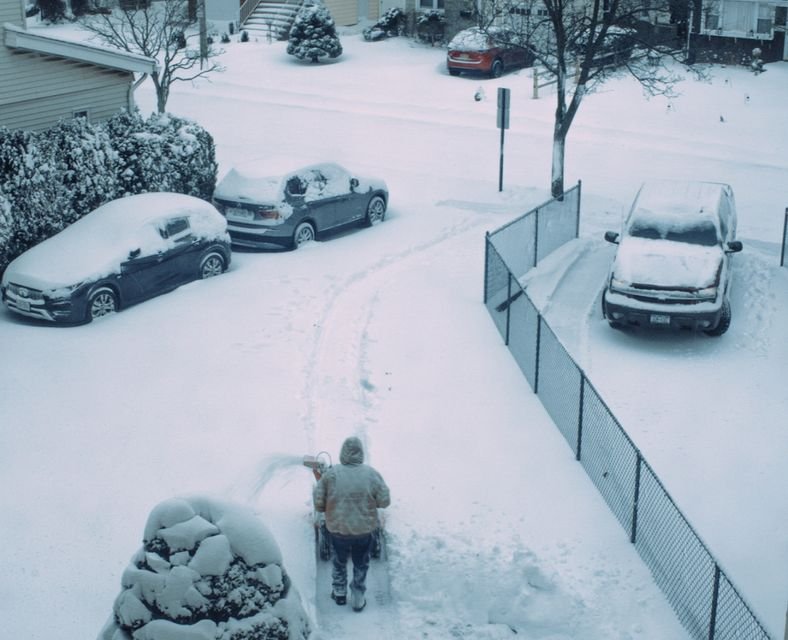
Per visit or seasonal for a first winter?
Per-visit billing pays for every visit, which is fair in heavy winters. Seasonal billing gives the customer a predictable price and the company predictable revenue. The worked example from the snow removal pricing calculator for landscapers shows what each choice means across two kinds of winter.
| Winter | Per-visit revenue | Seasonal price | Effective margin on the seasonal price |
|---|---|---|---|
| Light winter, 14 visits | 14 x $96.00 = $1,344.00 | $1,900.80 | 47.0% (cost $72.00 x 14 = $1,008.00) |
| Heavy winter, 24 visits | 24 x $96.00 = $2,304.00 | $1,900.80 | 9.1% (cost $72.00 x 24 = $1,728.00) |
In the light winter, the seasonal package pays $556.80 more than per-visit billing, and the margin on the package is 47.0 percent. In the heavy winter, per-visit billing would have paid $403.20 more, and the margin on the package falls to 9.1 percent. That is why the contract needs a visit cap with overage visits priced separately. Without the cap, a winter heavier than 24 visits keeps eroding the margin, and the buffer alone cannot carry it. A hybrid option also exists: a seasonal base fee plus per-visit charges above a set event count, which splits the weather risk between company and client.
For a first winter, the seasonal package is still the better offer for existing landscape clients, because it is simple to sell alongside a maintenance account and it books revenue before the first storm. The condition is that the cap, the trigger depth, and the salt treatment are all in writing before the season starts.
What does a 12-driveway route add over a winter?
One driveway at $1,900.80 is a useful check. A route is the business case. Twelve driveways on the same terms give seasonal revenue of 12 x $1,900.80, or $22,809.60, plus salt billed separately of 12 x $504.00, or $6,048.00. That route keeps a small crew working through the winter and turns idle equipment into revenue, provided the driveways sit close enough together that drive time between stops does not push the 0.75-hour visit time upward. Route density is therefore part of the price: a scattered set of twelve driveways costs more per visit than a tight route, and the time input should reflect that.
The snow removal pricing calculator for landscapers can price a commercial lot separately; the snow-contractor worked example for this calculator shows that angle with a lot-based seasonal contract.
Common input mistakes that underprice a first winter
The snow removal pricing calculator for landscapers only returns good prices for good inputs. Four mistakes recur on first winter quotes.
Guessing the time instead of measuring it. If the visit actually takes 0.75 hours but the quote uses 0.5 hours, the cost falls to $52.00, the price to $69.33, and the seasonal package to $1,372.80. That is $528.00 per driveway per season below the correct $1,900.80, lost on every driveway on the route.
Using a bare wage instead of a loaded rate. At $45 per hour instead of the loaded $80 per hour, labour is $33.75, cost is $45.75, price is $61.00, and the seasonal package is $1,207.80. That is $693.00 per driveway per season below the correct figure, and it leaves burden, fuel, and wear unpaid.
Including salt and then absorbing a price spike. If salt had been included in the package and the bag price rose from $28 to $38 mid-season, the extra cost would be $10 x 1 bag x 18 visits, or $180.00 per driveway, absorbed by the company. Billed separately, that increase passes through instead. Salt prices can spike mid-season, which is why many contractors bill it separately.
Quoting from square footage. The calculator treats area as context for sanity-checking the time estimate. Two driveways of the same size can take very different times if one is steep, gated, or far from the road. Price from measured time, and use area only to check whether the time looks plausible.
Frequently asked questions
Should a landscaper offer snow removal in the first winter, or wait a year?
Offer it to existing clients first, on a small route, with the trigger, cap, and salt treatment in writing. A small route limits the exposure if visit counts or times were estimated wrong. Price the package from costs with the snow removal pricing calculator for landscapers before quoting.
What trigger depth should a residential driveway package use?
Residential driveways often use 3 inches or more, while commercial lots often use 2 inches. Whatever the choice, put it in the contract so there is no early-morning debate about whether a visit counts, and pair it with a visit cap.
What happens if the winter is much heavier than expected?
The buffer and the visit cap share that risk. The buffer adds a percentage to the seasonal price, and the cap means visits above the cap are priced separately. Without a cap, a heavy winter keeps adding cost against a fixed price, and the effective margin falls as the worked example shows.
Does the calculator cover insurance and equipment payments?
Not as separate fields. Sidewalk-only routes, on-call staffing, equipment payments, and insurance are not included, so fold those costs into the per-visit overhead field before quoting.
Try it with your own numbers
Enter your measured visit time, loaded crew rate, overhead, salt cost, margin, expected visits, and buffer into the snow removal pricing calculator for landscapers and compare the per-visit price against the seasonal package before you quote a first winter route.
Photos: featured photo by Efrem Efre via Pexels; in-body photo by Zeeshaan Shabbir via Pexels.