
A seasonal snow contract asks you to set one price for a winter you haven’t seen yet. Get the visit count wrong, and you either leave money on the table in a light winter or work January for free in a heavy one.
This guide walks through the free snow removal pricing calculator for snow contractors using a sample commercial lot, the way a snow contractor would price it. You’ll see what each input means in trade terms, how the calculator turns those inputs into per-visit and seasonal prices, and what the results tell you about your risk. The lot, rates, and winter in this example are illustrative, but the calculator uses the same math with your own figures.
Why is seasonal snow pricing hard to get right?
Three things make a seasonal bid different from other quotes. First, you’re selling visits you haven’t made yet, so the contract price has to cover a visit count estimated from past winters. Second, salt prices can spike mid-season, and whether you include salt or bill it separately changes your exposure. Third, every seasonal contract needs agreement on both the price and the rules for what counts as a visit. Without a written trigger depth, the first light snowfall in December can start an argument at 6 a.m.
The snow removal pricing calculator for snow contractors handles the arithmetic: cost per visit, the correct margin calculation, and a seasonal total with a buffer for heavy winters. You still need to write the contract terms. This guide covers both.
What does the snow removal pricing calculator for snow contractors need?
Seven inputs, each tied to something you already know about your route. Here’s what each number means and where it should come from.
- Time on site per visit (hours). Plowing, stacking, and drive time between stops. Time drives the price, not square footage. The calculator’s area field is only there for context, to sanity-check your time estimate. A wide-open lot and a tight driveway of the same size can take very different amounts of time.
- Crew rate ($/hour). The fully loaded cost of the crew on that truck, not just the driver’s wage. If you haven’t calculated yours, the fully loaded labour rate calculator builds it from wages, burden, and overhead.
- Overhead per visit. Fuel, wear on the truck and plow, and your share of insurance for that route. The calculator doesn’t break these out separately, so include equipment payments and insurance in this field.
- Salt: bags per visit x bag cost. What you actually spread per visit at today’s bag price. If you bill salt separately, enter zero bags here and price it as its own line.
- Target margin (%). The margin you want on the selling price, not a markup on cost. The calculator divides cost by (1 – margin), so 25% means your margin is a quarter of the final price.
- Expected visits per season. Your best estimate from past winters for this property, using the trigger depth in your contract.
- Heavy-winter buffer (%). An extra amount built into the price for winters that exceed your visit estimate. The default is 15%, and the calculator’s own guidance calls it a judgment call. Adjust it to your winters and your tolerance, and pair it with a written visit cap.

How do you price a seasonal contract for a commercial lot?
Say you run a small snow and ice operation and you’re bidding a seasonal contract for a neighbourhood plaza lot. The property manager wants one fixed price for the season, with salt included and service at a 2-inch trigger. Here are the illustrative inputs:
| Input | Illustrative value | Where it comes from |
|---|---|---|
| Time on site per visit | 1.25 hours | Plow, stack, and drive time for this lot |
| Crew rate | $95/hour | Two-person crew, fully loaded |
| Overhead per visit | $18.00 | Fuel, truck and plow wear, insurance share |
| Salt | 2 bags x $32 | $64 per visit, included in the contract |
| Target margin | 25% | Margin on the final price |
| Expected visits | 22 | Past winters at a 2-inch trigger |
| Heavy-winter buffer | 15% | Starting default |
Enter those figures into the snow removal pricing calculator for snow contractors, and the math works out like this:
- Cost per visit: (1.25 x $95) + $18 + $64 = $118.75 + $18.00 + $64.00 = $200.75
- Price per visit at 25% margin: $200.75 / (1 – 0.25) = $200.75 / 0.75 = $267.67
- Seasonal price: $267.67 x 22 visits x 1.15 buffer = $6,771.97
- Salt for the season: $32 x 2 bags x 22 visits = $1,408.00 (already inside the $6,771.97)
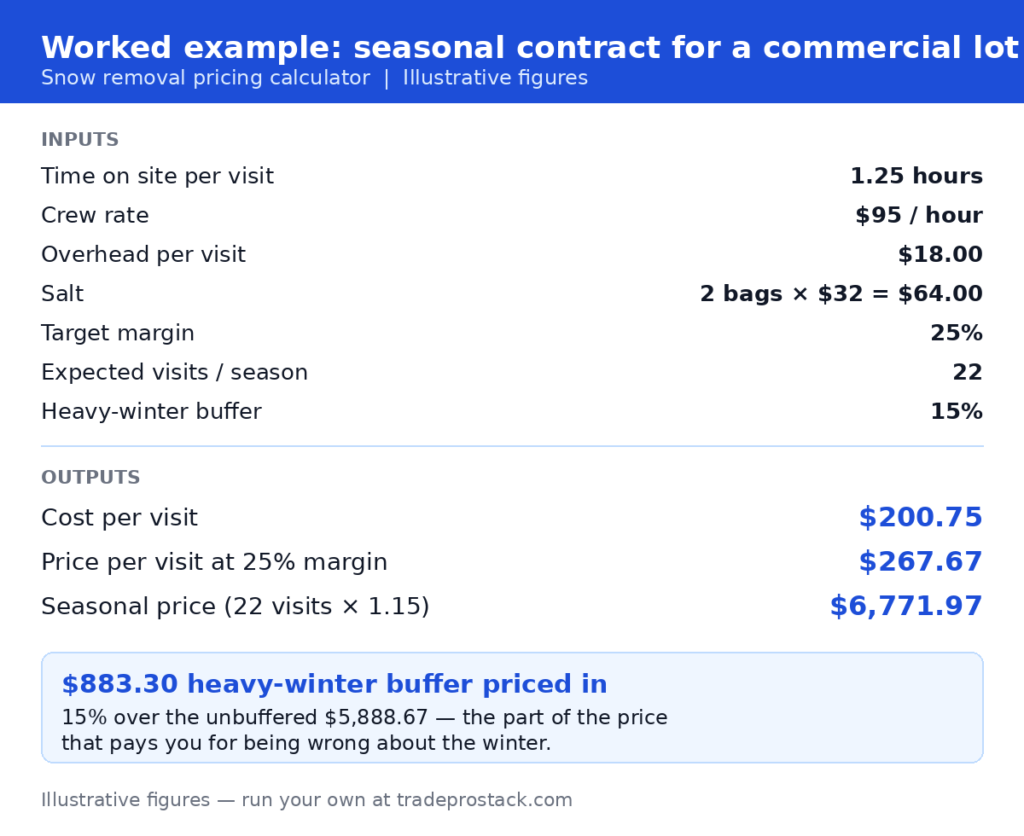
The worked example from this guide: seven inputs in, per-visit and seasonal prices out. Figures are illustrative.
If salt were billed separately instead of included, the same visit would cost $136.75 ($118.75 labour + $18 overhead), price at $182.33 a visit, and come to $4,613.03 for the season, with $1,408 of salt on its own line.
What does the seasonal price mean for this contractor?
First, it puts a dollar amount on the buffer. Without the 15% buffer, the seasonal price would be $267.67 x 22 = $5,888.67. The buffer adds $883.30. That’s what you’re charging to account for an unpredictable winter.
Second, it shows how different winters affect your margin. The plan assumes 22 visits at a cost of $200.75 each, or $4,416.50 for the season:
- A heavy winter, 28 visits: Your cost rises to $5,621.00 against the same $6,771.97 contract. Your effective margin drops from 25% to about 17.0%. The six extra visits cost $1,204.50 to service; the $883.30 buffer absorbs most of that, leaving $321.20 of exposure. Without the buffer, that exposure would have been the full $1,204.50.
- A light winter, 16 visits: Your cost is only $3,212.00 against the same contract, and the effective margin rises to about 52.6%. That’s the trade the customer makes for a predictable price. They overpay in light winters so they aren’t billed per push in heavy ones.
Third, it gives you a per-visit price to compare against per-push work. At $267.67 a visit with salt included, you can check whether your per-push rate for similar lots is in the same neighbourhood. If it isn’t, one of the two prices is wrong.
What should a snow contractor do with the result?
Write the trigger depth into the contract. The snow removal pricing calculator for snow contractors prices visits; the contract defines what counts as one. Commercial lots commonly use a 2-inch trigger, while residential driveways use 3 inches or more. Whatever you choose, put it in writing so a light dusting doesn’t turn into a billing dispute.
Cap the visit count and price overage visits separately. The seasonal price assumes 22 visits. State the cap in the contract and specify the per-visit price for anything beyond it. At $267.67 in this example, you already have that number without another round of math.
Decide where salt lives. You can include it, as in this example, or bill it separately per visit or per bag. Salt prices can spike mid-season, so many contractors bill it separately. If you include it, use the current bag cost instead of last year’s price.
Match the contract terms to the inputs. Your trigger depth, visit cap, and salt terms need to match what you entered into the snow removal pricing calculator for snow contractors. A seasonal price built on 22 visits with salt included can’t be sold with a 30-visit cap and salt extra.
What mistakes cost snow contractors margin?
Most of these come down to what gets typed into the snow removal pricing calculator for snow contractors.
- Leaving drive time out of the hours. Route gaps between lots are real costs. If the truck spends 20 minutes getting to the plaza, include that time in the per-visit hours.
- Entering the driver’s wage as the crew rate. Wages are only the starting point for crew costs. Burden, truck, fuel, and insurance costs come along with every hour.
- Pricing salt at last year’s bag price. Check the current price before you bid. A $4 move on a 2-bag visit is $8 a visit, or $176 across a 22-visit season.
- No trigger depth in writing. The calculator can’t settle whether Tuesday’s snowfall counted. Only the contract can.
- A 0% buffer in heavy-snow territory. The buffer is the part of the price that accounts for getting the winter forecast wrong. With zero buffer, every extra visit comes straight out of your margin.
- Treating the seasonal price as the whole quote. The price is only one line of the contract. Trigger depth, visit cap, overage rate, and salt terms are what protect it.
What do snow contractors commonly ask about seasonal pricing?
Per-push or seasonal: which is better for commercial lots?
Per-push pays you for every visit, which is fair in heavy winters. Seasonal gives the customer a predictable price and gives you predictable revenue. Many contractors offer seasonal pricing with salt or de-icing as a per-push option, keeping that volatile input outside the fixed price.
What trigger depth should go in the contract?
It depends on the property. Commercial lots often use a 2-inch trigger, while residential driveways are often 3 inches or more. Whatever you choose, write it into the contract along with the visit cap.
Should salt be included in the seasonal price or billed separately?
Either approach works if the math matches the contract. Including salt is simpler to sell, while billing it separately protects you when bag prices spike mid-season. If you include it, re-check the bag price before every bid.
What if it barely snows?
That’s the customer’s risk on a seasonal contract, and it’s part of what makes the price predictable for them. Your risk runs the other way, which is why you need a buffer and a visit cap. Some contractors use a hybrid approach: a seasonal base fee plus per-push charges above a set number of events.
How can you run your own numbers?
Enter your time on site, crew rate, salt cost, and margin into the snow removal pricing calculator for snow contractors to get your per-visit and seasonal prices, with the full calculation shown. It’s free to use, with no signup required.
Open the snow removal pricing calculator
What’s the short version?
A seasonal snow contract is a bet on the winter, and the snow removal pricing calculator for snow contractors puts a price on that risk. In this illustrative example, $200.75 a visit becomes $267.67 at a 25% margin, or $6,771.97 for a 22-visit season with a 15% buffer. Write the trigger depth and visit cap into the contract, make sure the salt terms match the math, and re-price when bag costs change. You’ll find this and more free pricing calculators on the free tools hub.