
A roofing crew can finish roof after roof through a busy stretch and still end the month wondering where the money went. The schedule looked full and the invoices went out, but the bank balance does not match the workload.
That gap usually comes down to one question: how much did each individual roof actually earn? A job price is not profit. Profit is what remains after labour, materials and every other cost of that specific roof are paid.
So, how much profit did that re-roof really make?
The free profit per job calculator for roofers from TradeProStack answers that question for one job at a time: enter the price and what the roof cost, and it shows the profit in dollars and the margin as a percentage.
How does the profit per job calculator for roofers work?
The calculator takes four inputs and turns them into two results. For a roofing company, those inputs map directly to a job costing sheet.
1. Job price. Enter the price charged for the roof: the selling price for that one job.
2. Labour cost. Enter what the crew cost for this roof. Use the loaded labour cost: wages plus employer burden such as payroll taxes, workers’ compensation and benefits. A wage of $25 per hour costs $30 to $33 per hour once burden is included, according to the calculator’s own guidance. Pricing labour at the wage alone understates the real cost of the crew.
3. Materials cost. Enter what the materials for this roof cost: shingles, underlayment, flashing, vents, nails and any other materials installed on that roof.
4. Other costs. Enter everything else the job cost beyond labour and materials: permits, disposal, equipment rental, subcontractors and card processing fees. For a roofer, the dumpster and disposal bill and the permit fee belong here, not in a forgotten corner of the estimate.
Here is how the profit per job calculator for roofers turns those four inputs into a result:
Profit = job price – (labour + materials + other costs)
Profit margin = profit / job price
The result is gross profit for that one job, before fixed overhead such as rent, insurance and office costs. It shows whether the roof itself made money, not whether the business was profitable for the month. The tool is free, requires no signup and was built by the TradeProStack Research Desk.
What did one re-roof earn on the profit per job calculator for roofers?
Let us use the profit per job calculator for roofers on an illustrative example: a roofing company pricing an asphalt shingle re-roof.
These figures demonstrate the calculator. They are not actual market prices or a quote for a real property, and every price, cost and percentage is illustrative.
Step 1: Enter the job price
The illustrative job price is $14,500, the amount charged for this one re-roof.
Step 2: Enter the loaded labour cost
The illustrative loaded crew cost is $4,800, already including employer burden. It is the full cost of the crew on this job, not the wage total alone.
Step 3: Enter the materials cost
The illustrative materials cost is $5,900, covering shingles, underlayment, flashing, vents and nails.
Step 4: Enter the other costs
The illustrative other costs total $1,100: $650 for dumpster rental and disposal, $250 for the permit and $200 for delivery and miscellaneous job costs. Each part is small on its own, but together they are $1,100 out of the job price.
$650 + $250 + $200 = $1,100
Step 5: Work out total costs, profit and margin
Now combine them:
$4,800 + $5,900 + $1,100 = $11,800
$14,500 – $11,800 = $2,700
$2,700 / $14,500 = 18.6%
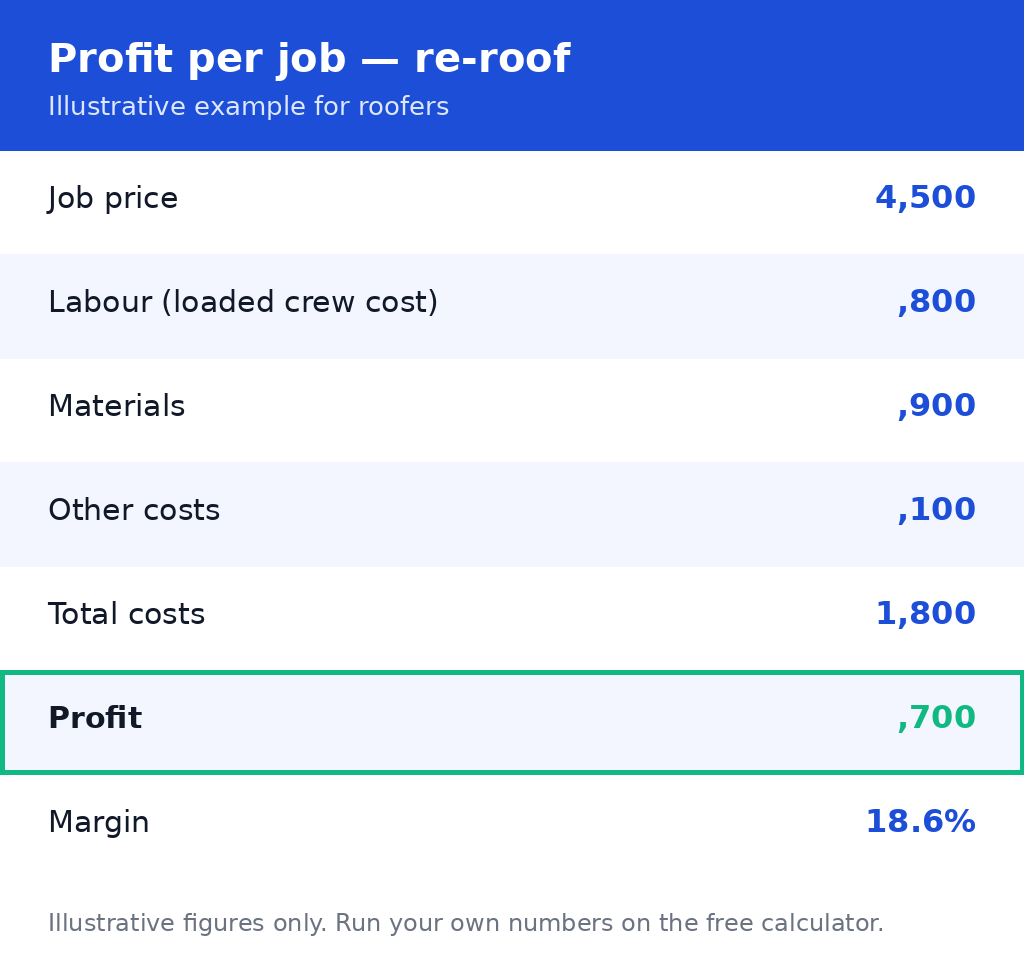
The illustrative result is $2,700 profit at an 18.6% margin for this re-roof.
Here is the complete calculation:
| Profit component | Illustrative amount |
|---|---|
| Job price | $14,500.00 |
| Labour (loaded crew cost) | $4,800.00 |
| Materials | $5,900.00 |
| Other (disposal $650 + permit $250 + misc $200) | $1,100.00 |
| Total job costs | $11,800.00 |
| Profit | $2,700.00 |
| Profit margin | 18.6% |
What does an 18.6% margin change for a roofing company?
The calculator’s guidance puts this result in context: a gross margin of 20% to 30% per job is a common target for small trade businesses, and a margin consistently under 15% is a sign to look closer at prices and costs.
At 18.6%, this illustrative re-roof sits between those two markers. It clears the 15% floor, so the roof is not losing ground, but it sits below the 20% to 30% target range. That tells the owner the roof made money, with room to improve before the next estimate goes out.
One way to use that information is to ask what price the same roof would need at a 25% margin. Divide the total costs by 0.75:
$11,800 / 0.75 = $15,733.33
At that price with the same costs, the profit would be $3,933.33 and the margin would be 25%: a $1,233.33 higher price than the illustrative $14,500, showing exactly what the margin target is worth in dollars on this roof. At three such roofs a month, the $2,700 per roof totals $8,100 before fixed overhead.
What mistakes can throw off a roofer’s profit check?
Small differences in how costs are entered can produce noticeably different profit figures. Here are four mistakes worth checking before trusting a result.

Mistake 1: Entering wages instead of loaded labour
Suppose the company enters $3,900 in wage-only labour instead of the $4,800 loaded crew cost. The calculation changes: costs become $3,900 + $5,900 + $1,100 = $10,900, apparent profit becomes $14,500 – $10,900 = $3,600, and apparent margin becomes $3,600 / $14,500 = 24.8%.
Compare that with the original result:
$3,600 – $2,700 = $900 per roof
At three illustrative re-roofs a month, that is $900 x 3 = $2,700 a month of profit that does not exist, because the burden on the crew’s wages was left out. If you are unsure what your crew truly costs per hour, use the labour rate calculator to work out the loaded rate first.
Mistake 2: Leaving other costs at zero
Suppose the company enters $0 for other costs, forgetting the dumpster and the permit. The calculation changes: costs become $4,800 + $5,900 + $0 = $10,700, apparent profit becomes $14,500 – $10,700 = $3,800, and apparent margin becomes $3,800 / $14,500 = 26.2%.
That overstates profit by $1,100 per roof, the exact amount of the disposal and permit costs left out. Disposal and permits are not overhead to be absorbed somewhere else. They are costs of this specific roof, and the calculator only counts them if they are entered.
Mistake 3: Judging a roof by profit dollars alone
Suppose a larger roof is priced at $22,000 with costs of $19,000. The profit is $3,000, which is $300 more than the $2,700 from the base example. But the margin is $3,000 / $22,000 = 13.6%, below the calculator’s 15% floor.
The bigger roof brings more profit dollars and a thinner margin at the same time. That matters because a thin margin leaves less room for a cost overrun, a callback or a price increase on materials. Dollars alone do not show that risk. The margin percentage does.
Mistake 4: Treating gross profit per job as business profit
If the $2,700 from the base example is treated as the month’s profit, the company’s fixed costs disappear from the picture. Rent, insurance and office costs still have to be paid, out of the gross profit of all the month’s jobs combined. The calculator answers whether one roof made money. Whether the business made money for the month is a separate calculation, starting from the per-job results.
What profit margin should a roofer target per job?
The calculator’s guidance identifies 20% to 30% gross margin per job as a common target for small trade businesses, with consistently under 15% as the point to look closer at prices and costs. The illustrative re-roof here lands at 18.6%, above the floor and below the target range. Your own target should be based on your company’s costs and pricing requirements. The calculator reports the margin your numbers produce. It cannot guarantee that margin if actual costs differ from the estimate.
Should labour cost be the wage or the loaded cost?
Always use the loaded cost. The calculator’s guidance gives the scale of the difference: a $25 per hour wage costs $30 to $33 per hour once employer burden is included. Pricing labour using wages alone makes every roof look more profitable than it is (see Mistake 1). The labour rate calculator can work out the loaded hourly cost if it is not already known.
What goes in other costs for a roofing job?
Include anything the roof costs beyond direct labour and materials: permits, dumpster rental and disposal fees, equipment rental, subcontractors, fuel for the job and card processing fees. Group smaller expenses together, but do not leave the field at zero. In this guide’s example, disposal at $650 and the permit at $250 are the two items most easily forgotten, and together they are $900 of the $1,100 other-costs total.
The calculator says the roof lost money. Now what?
Start by checking the inputs, especially the loaded labour cost and anything entered under other costs. A negative result means the job is losing money on the numbers entered. It is not a calculator error. If the loss is accurate, the options are to raise the price, reduce the cost or stop taking that type of work. The 25% margin check in this guide shows the reverse: it gives the price that would have been needed, so the next estimate can be set from a known target instead of a guess.
How can you check your next roof?
You do not need to rebuild the formula every time a roof is priced. Start with the price, enter the loaded crew cost, the materials and the other costs for that specific roof, then read both results: profit in dollars and margin as a percentage. Compare the margin with the 20% to 30% common target and the 15% floor, and check the price a higher target would require before the estimate goes out.
If the price itself still needs to be built, the job quote calculator can turn labour, materials, overhead and a target margin into a selling price. Run the price through the profit per job calculator for roofers afterwards to confirm what the roof actually keeps.
These calculations are pricing illustrations, not financial advice. Actual profits and margins will depend on the work and your company’s circumstances.
Photos: Ryan Stephens and Ryan Stephens via Pexels.
Ready to check your next roof?
Run your own numbers with the free profit per job calculator for roofers. No signup required.