
Quoting a residential panel upgrade can be tricky for a small electrical shop. You have labour hours to account for, a parts list that includes the panel, breakers and wire, and overhead costs that need to come out of the job revenue. Then there is the profit you actually want to make.
It is easy to underestimate one of those costs when you are putting together an estimate. You might price the labour correctly but forget to mark up materials. Or you might add 15% to your costs and assume that gives you a 15% profit margin.
So, how much should you quote for a panel upgrade?
The free job quote calculator for electricians from TradeProStack gives small electrical shops a repeatable way to build a flat-rate quote from labour, marked-up materials, overhead and a target profit margin.
Let us work through an illustrative residential 100A to 200A panel upgrade and see how the numbers come together.
How does the job quote calculator for electricians work?
The calculator takes four inputs and uses them to calculate a selling price. For an electrical contractor, those inputs correspond to the numbers you would normally work through when preparing an estimate.
1. Labour hours and hourly rate. Enter the number of labour hours you have budgeted for the job and the hourly rate you are using. For a panel upgrade, that is the labour allowance you have built into the estimate. The calculator multiplies the hours by your rate to get the labour cost.
2. Materials and materials markup. Enter your materials cost and the percentage you want to mark it up. For an electrician, materials might include the panel, breakers, mast, wire and an electrical permit pass-through. The exact parts and costs depend on the job and must be established separately. The markup applies to materials only. It gets added before the calculator factors in overhead and profit.
3. Overhead percentage. Enter an overhead percentage based on the labour-plus-marked-up-materials subtotal. This is a quick way to allocate overhead to the job. It is not a complete calculation of your shop’s operating costs, so use the labour rate calculator to work out a more exact hourly cost.
4. Target profit margin. Finally, enter your desired profit margin. The calculator treats this percentage as a margin on the final selling price. That is important because a 15% margin and a 15% markup produce different prices.
Here is how the job quote calculator for electricians turns those four inputs into a price:
Price = (labour + materials x (1 + markup) + overhead) / (1 – profit margin)
In shop terms, you are adding up the labour, marked-up parts and overhead allowance, then calculating the price needed to achieve your target margin. Sales tax gets added on top of the calculated quote price. The tool is free, requires no signup and was built by the TradeProStack Research Desk.
How much would you quote for a 100A to 200A panel upgrade?
Let us use the job quote calculator for electricians on an illustrative example: a two-tech electrical shop preparing a residential 100A to 200A panel upgrade estimate.
These figures are for demonstrating the calculator, not actual market prices or a quote for a real property. The labour allowance, materials cost and percentages are all illustrative.
Step 1: Calculate labour
The shop budgets six labour hours at an hourly rate of $95.
6 hours x $95/hr = $570
Enter six hours and $95 per hour into the job quote calculator for electricians. That gives $570 in labour cost for this illustrative job.
Step 2: Add the materials markup
The illustrative materials cost is $680. The shop chooses a 25% markup to account for the costs associated with supplying and handling those materials.
$680 x 1.25 = $850
That is $170 added to the original materials cost. Materials markup helps account for expenses such as supplier trips, handling, warranty risk and cash tied up in stock. These are real considerations when a small shop supplies parts for a job.
The calculator now has $570 in labour and $850 in marked-up materials.
Step 3: Calculate the subtotal
Add labour and marked-up materials:
$570 + $850 = $1,420
This is the subtotal used for the overhead calculation. Notice that the markup has already been applied to materials. We have not calculated the final profit margin yet.
Step 4: Allow for overhead
The illustrative shop uses a 12% overhead allowance. The calculator applies that percentage to the $1,420 subtotal.
$1,420 x 12% = $170.40
Add overhead to the subtotal:
$1,420 + $170.40 = $1,590.40
That is the calculated amount before applying the desired profit margin. Without this step, the shop’s quote would leave out its overhead allowance. For an owner-operator, that can make a job appear more profitable than the calculation actually supports.
Step 5: Apply the 15% profit margin
The shop wants a 15% profit margin on the final selling price. To calculate that margin correctly, divide the amount before profit by 0.85.
$1,590.40 / 0.85 = $1,871.06
The calculator produces an illustrative quote of $1,871.06, or about $1,871 before sales tax.
Here is the complete calculation:
| Quote component | Illustrative amount |
|---|---|
| Labour: 6 hours x $95/hr | $570.00 |
| Materials: $680 x 1.25 | $850.00 |
| Subtotal | $1,420.00 |
| Overhead: 12% | $170.40 |
| Cost before profit | $1,590.40 |
| Target profit margin | 15% |
| Final quote, before sales tax | $1,871.06 |
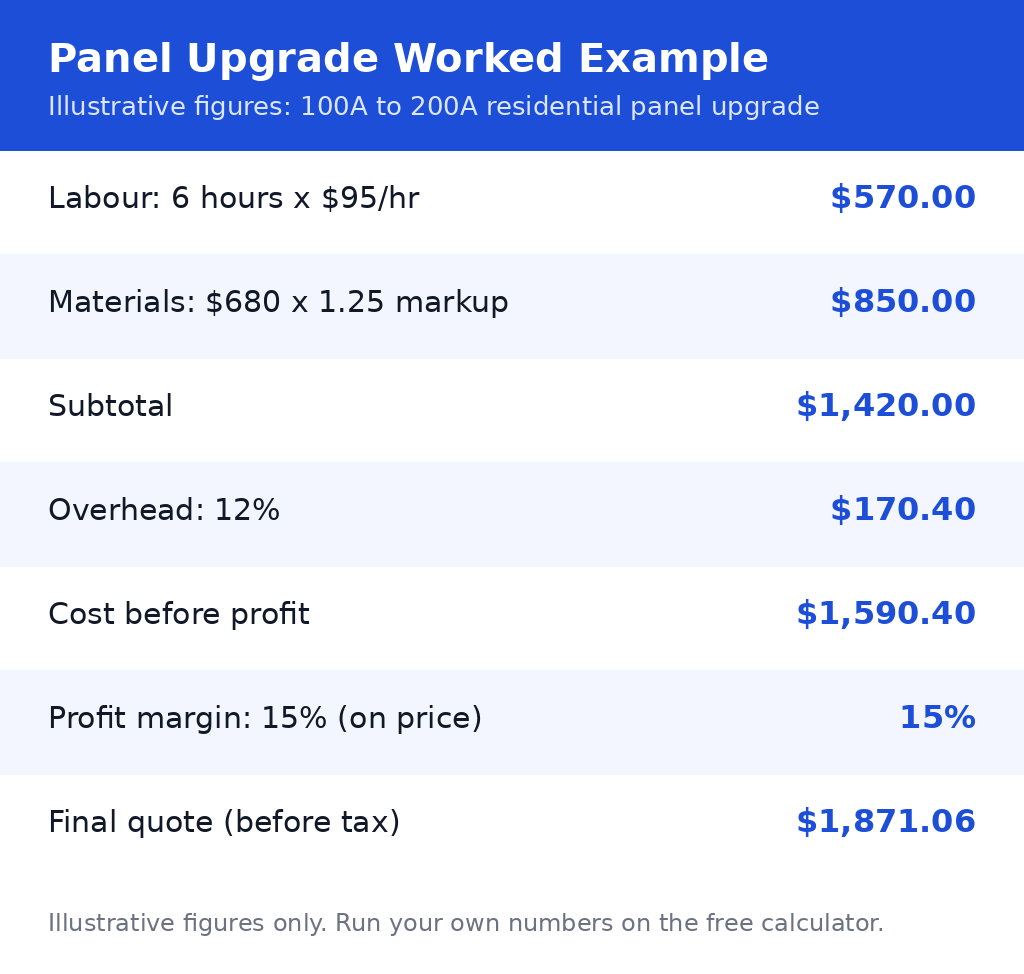
This gives the shop a clear starting point for a flat-rate estimate, provided its inputs accurately reflect the work being quoted.
What changes when you use the result as a flat-rate quote?
Most customers want to know the total price of the job. They generally are not looking for a separate explanation of every hour, breaker and overhead percentage.
With the calculator, the electrical shop can work through the costs internally and present a flat-rate price to the customer. In our illustrative job quote calculator for electricians run, the calculated price is about $1,871 before sales tax. The shop can retain the full breakdown in its own estimating records, including the labour allowance, materials markup and overhead percentage.
That makes the calculation easier to review when preparing another estimate. If the next panel upgrade has different labour requirements or materials costs, the shop can update the inputs instead of guessing at a new selling price.
What does that mean across four panel upgrades?
Suppose the illustrative shop quotes four panel upgrades in a month, all using the same assumptions.
At $1,871.06 per job, the four quotes total:
$1,871.06 x 4 = $7,484.24 before sales tax
That is a hypothetical total quoted amount, not a revenue forecast or a claim about actual electrical shop earnings. The useful part is that each estimate includes an explicit overhead allowance and a target profit margin. Those amounts are accounted for in the calculation instead of being left to whatever remains after the work is completed.
What mistakes can throw off an electrician’s quote?
Small differences in how you enter materials or apply profit can produce noticeably different selling prices. Here are four mistakes worth checking before you send an estimate.
Mistake 1: Skipping the materials markup
Suppose our illustrative shop enters the $680 materials cost without applying the 25% markup. The calculation changes: labour $570, unmarked materials $680, subtotal $1,250, overhead at 12% = $150, cost before profit $1,400, price at 15% margin = $1,400 / 0.85 = $1,647.06.
Compare that with the original job quote calculator for electricians result:
$1,871.06 – $1,647.06 = $224.00 per job
At four illustrative panel upgrades a month: $224.00 x 4 = $896/month. That is $896 less in quoted revenue each month under these assumptions.
Materials markup matters because buying and supplying parts creates costs beyond the original purchase amount. Ignoring the markup removes that allowance from your quote.
Mistake 2: Confusing markup with profit margin
Another common mistake is adding 15% to the amount before profit and calling that a 15% margin. Using the illustrative $1,590.40 amount: $1,590.40 x 1.15 = $1,828.96. That looks close to the calculator’s result, but the actual margin is ($1,828.96 – $1,590.40) / $1,828.96 = 13.04%. That is about 13%, not 15%.
The difference in selling price is $1,871.06 – $1,828.96 = $42.10 per job. Across four illustrative jobs, that is about $168.40 per month in additional quoted revenue when using the correct margin calculation.
The distinction is straightforward: markup is measured against cost, while margin is measured against selling price. When you enter 15% into the job quote calculator for electricians, it divides by 0.85 to calculate the required selling price.
Mistake 3: Entering zero overhead
If you enter zero for overhead, the calculator will not include an overhead allowance in your price. For a small electrical shop, that can leave part of the business’s operating costs out of the estimate.
The percentage-based overhead input is meant to be a quick approximation. If you need a more accurate understanding of what your labour actually costs, calculate your hourly cost separately before preparing the quote.
Mistake 4: Forgetting that tax goes on top
The quote calculator produces a selling price before sales tax. In the illustrative example, $1,871.06 is the calculated quote before tax. Any applicable sales tax gets added on top. Keep that distinction clear when preparing the customer-facing estimate so the calculated amount is not mistaken for a tax-inclusive total.
Should electricians mark up materials?
Yes, a materials markup can help account for the additional costs of supplying parts. The calculator’s own guidance identifies 15-25% as a common materials markup range for small trade shops. Handling, supplier trips, warranty risk and money tied up in stock are all reasons an electrical contractor might build markup into a parts estimate. The appropriate percentage for an individual shop is still a business decision. The job quote calculator for electricians applies that percentage only to materials, before overhead and profit.
What profit margin should a small electrical shop target?
The calculator’s guidance identifies 10-20% as a common net margin target range for small trade businesses. Our illustrative panel upgrade uses 15%. Your target should be based on your shop’s own costs and pricing requirements. The calculator uses the entered margin to work backward to the required selling price, but it cannot guarantee the job will achieve that margin if actual costs differ.
Does the job quote calculator for electricians include sales tax?
No. Sales tax is added on top of the calculated quote. Make sure you distinguish the pre-tax selling price from the final amount shown to the customer.
Should electricians quote hourly or flat-rate?
For customers, a flat-rate price is generally easier to understand. The calculator lets you build that price from your hourly labour cost, materials, overhead allowance and desired margin. You can show the customer the total price while keeping the underlying cost calculation for your shop’s records. The key is making sure the labour hours and other inputs reflect the job you are estimating.
How can you calculate your next electrical job quote?
You do not need to rebuild the formula every time you price a service call, estimate or panel upgrade. Start with the hours and hourly rate you have budgeted, enter the relevant materials and markup, then set your overhead allowance and target profit margin. Review the result against the work being quoted before putting the total into your estimate.
If you are unsure whether your hourly rate accurately covers your shop’s costs, use the labour rate calculator to establish a more exact hourly cost first.
These calculations are pricing illustrations, not financial advice. Actual job costs and achieved margins will depend on the work and your shop’s circumstances.
Ready to price your next panel upgrade?
Run your own numbers with the free job quote calculator for electricians. No signup required.