Many electrical shops send a licensed electrician and an apprentice out together, then bill the job at the licensed electrician’s hourly rate alone. The crew works as a pair, but the price covers only one person’s loaded cost, and the shop absorbs the apprentice’s cost on every crew-hour it bills.
This guide works through the free labour rate calculator for electricians with an illustrative electrical shop that prices a two-person crew as one billing unit. You will see what each input means in electrical terms, how to combine two wages into one crew rate, and what the result changes about quoting crew work. All example figures are illustrative; the calculator uses the same math with your own figures.
What does the labour rate calculator for electricians need?
The calculator needs six inputs, and each one can move the result enough to matter. Check where each number comes from before entering it.
- Hourly wage. What you pay per hour before additional employment costs. For a crew, the worked example below enters the two wages combined, so one tool run prices the whole crew.
- Employer burden (%). Costs on top of wages: CPP and EI contributions, workers compensation premiums, vacation pay, stat holidays, and benefits. Check a payroll summary for the actual figure, and check your numbers against CRA figures for the relevant tax year before quoting work.
- Paid hours per year. A full-time crew member is paid for about 2,080 hours a year (40 hours times 52 weeks), including non-billable time. The billing unit below is the shared crew-hour, not the sum of two people’s hours.
- Utilization (%). The percentage of paid hours that can actually be billed to customers. Driving, quoting, waiting on inspections, callbacks, and paperwork all take paid time. One utilization figure applies to the crew-hour.
- Monthly overhead. Costs the business carries whether jobs come in or not: truck payments, fuel, insurance, shop rent, phones, software, tools, and accounting. A crew shares one truck, so the crew rate counts that overhead once.
- Target profit (%). The margin you want after covering all costs. The calculator divides by (1 minus profit%), so a 15% target means profit is 15% of the final rate, not a markup on cost.
The worked example: one crew, one crew-hour rate
Say you run a small electrical shop with one licensed electrician at $48.00 an hour and one apprentice at $26.00 an hour, working together as a crew. The shop currently bills crew work at the licensed electrician’s solo rate. The table lists the six inputs the labour rate calculator for electricians uses for the crew run.
| Input | Crew run |
|---|---|
| Hourly wage (combined) | $74.00 ($48.00 + $26.00) |
| Employer burden | 25% |
| Paid hours / year | 2,080 |
| Utilization | 70% |
| Monthly overhead (shared, counted once) | $1,800 |
| Target profit | 15% |
Enter the combined wage first. Annual pay is $74.00 times 2,080, which is $153,920.00. Employer burden at 25% adds $38,480.00, bringing loaded pay to $192,400.00. Annual overhead is $1,800 times 12, which is $21,600.00, so annual loaded cost is $214,000.00.
Billable crew-hours are 2,080 times 70%, which is 1,456 crew-hours. Loaded cost per paid hour is $214,000.00 divided by 2,080, which is $102.88. The break-even billable rate is $214,000.00 divided by 1,456, which is $146.98 per crew-hour. The rate with 15% profit is $146.98 divided by 0.85, which is $172.92 per crew-hour. Recomputing from the rounded break-even can differ by a cent; the calculator works from unrounded values.
The combined run can be cross-checked by running each crew member separately, with overhead counted once. The licensed electrician alone (same inputs, $1,800 monthly overhead) gives an annual loaded cost of $146,400.00, a loaded cost per paid hour of $70.38, a break-even rate of $100.55, and a rate with profit of $118.29.
The apprentice alone (same inputs, no separate overhead) gives an annual loaded cost of $67,600.00, a break-even rate of $46.43, and a rate with profit of $54.62. The two displayed rates add to $172.91, one cent below the combined crew rate of $172.92 from rounding. The two methods agree, and the combined run gives the crew rate in one pass. The plumbers guide works the single-tech case, and the HVAC guide works two separate rates.
What does billing the crew at the solo rate actually do?
Compare the shop’s current practice with the crew rate. Billing the crew at the licensed electrician’s solo rate of $118.29 falls $54.63 per crew-hour short of the $172.92 crew rate. Over 1,456 billable crew-hours, that shortfall is $79,541. This is a different kind of problem from a missed profit target alone: $118.29 also falls below the crew break-even rate of $146.98, so crew work billed at the solo rate does not cover the crew’s loaded cost, before profit is considered at all.
The error is easy to miss because every invoice looks tidy, and the shortfall shows up only later, as a year in which crew jobs never quite cover wages, burden, truck costs, and overhead together. Pricing the crew-hour correctly moves that discovery to the quoting stage, where the rate can still be fixed.
Why does utilization move the crew rate more than wages do?
Keep the crew’s costs the same and change only utilization. At 60%, billable crew-hours fall from 1,456 to 1,248, the break-even rate rises to $171.47, and the rate with 15% profit rises to $201.73: $28.81 per crew-hour above the 70% crew rate, from a 10-point change in one input, without a wage increase. At 80%, billable crew-hours rise to 1,664, the break-even rate falls to $128.61, and the rate with 15% profit falls to $151.30: $21.62 per crew-hour below the 70% crew rate.
No shop should set its year-round crew rate from one busy or slow stretch. Use a full-year average of billed crew-hours against paid hours, drawn from invoices. To check the actual figure, use the technician utilization calculator. Its output for a crew is a crew utilization figure, applied once to the crew-hour, not once per person.

What should an electrical shop do with the crew rate?
Put the crew rate into the matching price book. Jobs staffed by the pair carry labour at $172.92 per crew-hour. Jobs staffed by the licensed electrician alone carry labour at $118.29 per hour. The price book should name the crew composition behind each labour line, so a task price is not built on the wrong staffing model.
Re-run the calculation when the inputs change. Wage increases, an apprentice moving to a higher rate, a new truck, higher rent, and more driving can all change a required rate. Recalculate at least twice a year and whenever a crew member receives a raise. Running the labour rate calculator for electricians again takes a few minutes, so there is no reason to let a stale rate ride through a full season.
What mistakes throw off an electrical crew rate?
Each mistake below changes what the labour rate calculator for electricians returns, so check them before trusting a rate.
- Billing a two-person crew at the solo rate. The solo rate of $118.29 leaves $54.63 per crew-hour unpriced against the $172.92 crew rate, or $79,541 over 1,456 crew-hours, and falls below the crew break-even rate.
- Counting shared overhead twice. Entering the $1,800 shared monthly overhead for both crew members, $3,600 a month in total, gives an annual loaded cost of $235,600.00, a break-even rate of $161.81, and a rate with profit of $190.37. That overcharges by $17.45 per crew-hour, or $25,407 over a year of crew-hours, and risks losing bids the shop could profitably win.
- Dividing by summed person-hours. Dividing the same $214,000.00 annual loaded cost by 2,912 person-hours (1,456 plus 1,456) gives a break-even rate of $73.49 and a rate with profit of $86.46. That figure prices one person’s hour, not one crew-hour, and sits far below the $146.98 crew break-even. The pair works the same hours together, so crew-hours are the billing unit.
- Using take-home pay as the wage. Enter gross wages. The calculator adds employer burden separately, so take-home pay understates each crew member’s cost twice over: once in the wage and once in the burden calculated on it.
- Guessing burden instead of checking payroll. Add CPP, EI, workers compensation, vacation pay, and benefits from an actual payroll month. The full cost applies to both crew members.
- Pricing on a single season’s utilization. Setting the crew rate from a busy stretch or a slow stretch alone moves the rate by tens of dollars per crew-hour, as the sensitivity figures above show. Use a full-year average.
- Treating the labour rate as a complete quote. The result gives labour rates for pricing work; individual quotes still need parts, permits, inspection fees, disposal, and other job-specific costs.
Frequently asked questions
Should the apprentice be billed as a separate hourly line?
Not when the pair works as one crew. A separate apprentice line at $54.62 plus a solo line at $118.29 totals $172.91 before rounding, matching the combined crew rate. The crew rate states that total as one billable unit, which is clearer on a quote and harder to under-price by accident.
Does this replace flat-rate pricing?
No. The calculated rates are inputs for flat-rate pricing: task prices use expected crew-hours times the crew rate, plus parts and markup.
What if the calculated crew rate is well above the local market?
Review the inputs first, particularly utilization and overhead. Better routing, stocked trucks, and fewer callbacks may improve billable crew-hours. Charging below the $146.98 crew break-even to match competitors means absorbing a loss on crew work, so a rate above the market is a prompt to check costs, not to ignore the calculation.
How often should an electrical shop recalculate its crew rate?
At least twice a year and whenever wages change. Apprentice rate steps, insurance renewals, new truck payments, and slower months can also affect the rate.
How should electrical shops use this on the next rate review?
Run the crew through the labour rate calculator for electricians as one billing unit and set the crew rate from its own costs: $172.92 per crew-hour with 15% profit, instead of $118.29 for the pair. Use $118.29 only for work the licensed electrician genuinely does alone. The result is a planning estimate, not financial or tax advice. Check burden figures against payroll and CRA figures before quoting. More free pricing and quoting calculators are on the free tools hub.
Try this calculator: Run your own crew figures through the free labour rate calculator for electricians and compare the crew rate with the rate you charge today, using a full-year utilization figure and overhead counted once for the shared crew.
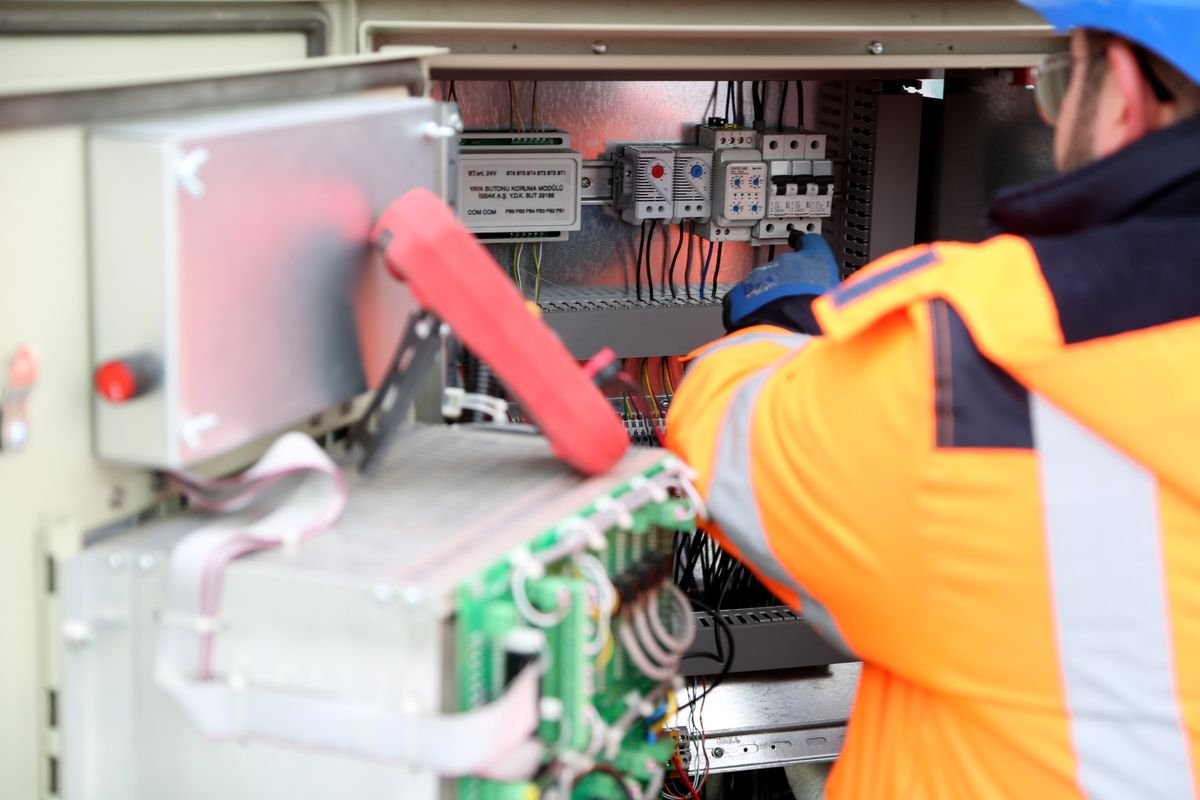
Photos: two construction workers installing an electrical panel by Nelson Axigoth on Pexels; electrician on a ladder fixing tangled power lines by Roland DRz on Pexels.