The first cold snap hits, and suddenly the phone won’t stop ringing. No-heat calls come in alongside fall tune-up requests and repair inquiries. Your techs are in attics and crawlspaces, and whoever handles the phones is trying to keep up.
For a small HVAC shop with one person in the office, or an owner answering between jobs, some calls will go unanswered. The question is how much potential work those calls represent during the fall heating changeover.
The free missed call cost calculator for HVAC shops from the TradeProStack Research Desk helps put an illustrative dollar figure on that question. You enter your call volume, missed-call percentage, booking rate, working weeks and average job value. The calculator estimates how much revenue could be at risk.
We’ll walk through an illustrative eight-week fall changeover scenario, using a shop that receives 60 calls a week and misses 30% of them. The example shows how quickly those unanswered calls can add up, and how to use the estimate when deciding whether your phone coverage needs attention.
What does the missed call cost calculator for hvac actually measure?
The calculator estimates revenue at risk from missed new-customer calls. It uses your call volume and booking assumptions to estimate how many potential jobs could go unbooked, then multiplies that number by your average job value.
It does not verify that those customers would have hired you. The result is an illustrative estimate of possible missed revenue, based on the numbers you enter.
There’s an important distinction in what counts as a missed call. For this calculation, a missed call means a missed lead: someone who could have booked new work but didn’t get an answer. That is the definition the missed call cost calculator for hvac uses: only calls that could have become new jobs belong in the inputs.
If a family member calls your business phone, that isn’t a missed lead. Neither is an existing customer calling with a question about an appointment. Those calls don’t belong in this calculation unless they represent an opportunity for new work.
Repeat callers also matter. If a potential customer calls twice and nobody answers either time, the calculator treats that as two missed calls. It counts call events, not unique people.
Finally, the result is revenue, not profit. The calculator doesn’t deduct labour, materials, fuel or overhead. That distinction matters when you start comparing missed-call estimates against the cost of fixing your phone coverage.

Which five inputs does the missed call cost calculator for hvac need during changeover season?
The missed call cost calculator for hvac asks for five numbers. Each one should reflect the period you’re trying to understand, particularly if fall heating demand looks different from the rest of your year.
Incoming calls per week. Start with the number of calls your shop receives in a typical week during the changeover period. Include the relevant new-customer call opportunities, whether they’re no-heat inquiries, tune-up requests or service calls. Keep your input consistent with the missed-lead definition.
The first cold snap may produce a different call pattern from a quieter week. If you’re trying to measure the fall rush, use a weekly figure that represents that period.
Missed percentage. This is the share of incoming calls that go unanswered. For an HVAC shop, consider what happens when the office person is occupied, the owner is working on a job, or calls arrive after hours.
Check your phone records rather than relying entirely on memory. If you’re reviewing unanswered calls, separate genuine new-job opportunities from calls that wouldn’t have created additional work. For after-hours situations, the after-hours emergency call handling guide provides related context.
Booking percentage. This is the share of answered new-customer calls that become booked jobs. It isn’t your overall close rate on estimates, quotes or later follow-ups.
For example, if you book about half of the new-customer calls you answer, a 50% booking rate is a reasonable starting assumption. You can refine that figure after tracking actual calls and bookings.
Working weeks. Enter the number of weeks you want to measure. For the fall changeover example below, we’ll use eight weeks rather than stretching the seasonal call volume across an entire year.
You can also calculate a full-year estimate, but be careful about what that assumes. Using your busiest weekly call volume for 52 weeks treats every week as though it were changeover season.
Average job value. Enter an illustrative blended average for the types of work those calls might generate. In HVAC, that can combine smaller tune-ups, diagnostic-and-repair visits and the occasional changeout that begins as a service call.
One average can hide substantial differences between job types. If your work varies widely in value, run the calculator separately for each job type to understand the potential revenue at risk in each category.
How much could an HVAC shop miss during an eight-week heating changeover?
Let’s run the missed call cost calculator for hvac on an illustrative HVAC shop working through an eight-week fall heating changeover. It receives 60 incoming calls per week, misses 30% of them and books 45% of the new-customer calls it answers.
We’ll assume a blended average job value of $450. This illustrative figure represents a mix of tune-ups, diagnostic-and-repair visits and occasional changeouts that begin as service calls.
These are example figures, not measured results from a real HVAC business. You can substitute your own numbers in the free Missed-Call Cost Calculator.
| Step | Illustrative calculation | Result |
|---|---|---|
| 1. Missed calls per week | 60 x 0.30 = 18 | 18 missed calls per week |
| 2. Missed bookings per week | 18 x 0.45 = 8.1 | About 8 missed bookings per week |
| 3. Missed bookings over eight weeks | 8.1 x 8 = 64.8 | About 65 missed bookings |
| 4. Seasonal revenue at risk | 64.8 x $450 = $29,160 | About $29,000 over eight weeks |
| 5. Monthly missed bookings during the push | 8.1 x 4.33 = 35.07 | 35.07 missed bookings per month |
| 6. Monthly revenue at risk | 35.07 missed bookings per month x $450 = $15,783 | About $15,800 per month |
| 7. Full-year missed bookings at the same weekly rates | 8.1 x 52 = 421.2 | Roughly 421 missed bookings per year |
| 8. Full-year revenue at risk | 421.2 x $450 = $189,540 | About $190,000 annually |
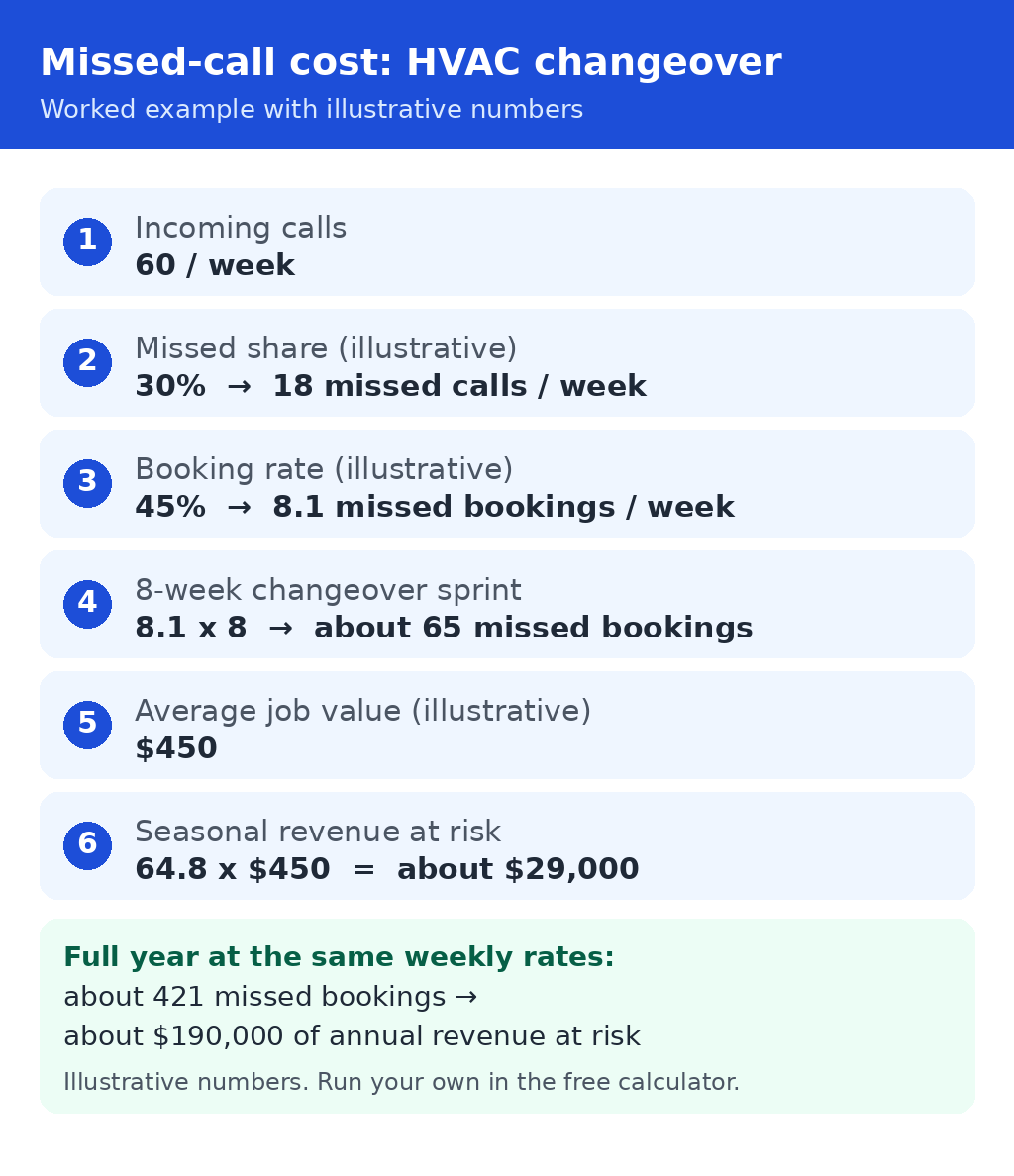
In this illustrative scenario, the shop misses 18 calls per week. Applying the 45% booking rate produces 8.1 potentially missed bookings each week, or about eight when rounded for display.
Across the eight-week fall changeover, that becomes 64.8 potential bookings, or approximately 65. At an illustrative blended job value of $450, the seasonal revenue at risk is $29,160, or about $29,000.
The monthly comparison is useful when you’re considering a recurring cost for phone coverage. During this illustrative changeover push, the estimate is about $15,800 in revenue at risk per month.
The full-year version produces a much larger number: approximately $190,000. But that assumes the same 60 incoming calls per week, 30% missed-call rate, 45% booking rate and $450 job value continue for all 52 weeks.
That’s a different assumption from measuring an eight-week fall rush. If your call volume changes outside heating season, the full-year projection based on peak-season rates may not represent your actual annual exposure.
The missed call cost calculator for hvac rounds booking counts for display while using unrounded figures for revenue calculations. Keep that in mind when comparing the displayed booking totals with the dollar estimates.
What should an HVAC owner do with the missed-call estimate?
The useful question is whether improving phone coverage would be worth the expense. The calculator provides an illustrative revenue figure that you can compare against the cost of a potential solution.
In our example, about $15,800 in monthly revenue is at risk during the changeover push. That doesn’t mean a new phone arrangement would recover $15,800 a month, because the estimate assumes those missed leads would book at the same rate as answered calls.
It also doesn’t mean that $15,800 would become profit. Any additional completed jobs would still have labour, materials, fuel and overhead costs.
There are a few options worth comparing:
- An answering service: Consider whether outside call coverage could address unanswered calls during busy periods.
- A dedicated office person: Compare the cost of additional phone coverage with the scale of the potential bookings being missed.
- An after-hours call-back system: Consider how missed inquiries could be followed up when nobody is available to answer immediately.
Compare the monthly cost of each option with the monthly missed-call estimate, while accounting for the fact that revenue at risk isn’t guaranteed recovered revenue. The numbers help establish whether further investigation makes financial sense.
If you’re evaluating phone follow-up approaches, the missed-call text-back versus AI receptionist comparison is another resource to review.
For HVAC and plumbing companies, emergency calls bring an additional consideration. As the calculator page notes, emergency calls go to whoever picks up. During a no-heat rush, that makes unanswered new-customer calls particularly relevant to the coverage decision.
Which input mistakes can make the estimate misleading?
The missed call cost calculator for hvac uses a straightforward formula, but the output depends on what you enter. These are the main mistakes to watch for when calculating missed-call exposure for an HVAC shop.
Counting calls that aren’t new-job leads. Calls from family or existing customers asking questions don’t belong in the missed-lead count. Including them makes your missed-opportunity estimate less meaningful.
Using your overall sales close rate. The booking percentage refers specifically to answered new-customer calls that become booked work. A close rate from quotes or later follow-ups measures something different.
Using one average job value for very different jobs. A tune-up and a changeout can represent very different amounts of revenue. When your job values vary widely, calculate each type separately rather than relying entirely on a blended average.
Reading revenue at risk as lost profit. The figure doesn’t subtract labour, materials, fuel or overhead. Don’t use it as though it represents money your business would have kept after completing the work.
Counting unique callers instead of call events. Under the tool’s assumptions, one potential customer who calls twice without getting an answer represents two missed calls. Don’t change that counting method halfway through your calculation.
Mixing seasonal and annual call volumes. Using a flat annual weekly average can hide what happens during a fall changeover rush. Applying your changeover-season rate to all 52 weeks can also misrepresent the full year. Match the call-volume assumption to the period you’re measuring.
You don’t need perfect data to start. A best estimate can show the possible scale of the issue, provided you understand what each assumption means. Refine your inputs as you collect better call and booking records.
What else should HVAC owners know before running the missed call cost calculator for hvac?
How can I find my real missed-call count?
Check your phone records and compare them with booked jobs. Pay particular attention to calls received while technicians or owners are on jobs, after hours and on weekends. Separate unanswered new-customer opportunities from calls that wouldn’t have resulted in additional work.
What booking rate should I start with?
Use your best estimate of the percentage of answered new-customer calls that become bookings. If you typically book about half of those calls, start with 50%. Refine the percentage once you’ve tracked enough calls and bookings to make a better estimate.
Should I use peak-season numbers or my annual average?
Use the numbers that match the decision you’re making. If you’re assessing phone coverage for an eight-week heating changeover, calculate that period using changeover-season assumptions. If you’re evaluating coverage for the full year, use inputs that represent the full year instead of assuming every week looks like your busiest period.
Does the calculator show how much profit I’ve lost?
No. It estimates potential revenue at risk from missed new-customer calls. It doesn’t verify lost bookings or subtract the costs of completing those jobs, so the figure shouldn’t be treated as lost profit or guaranteed recoverable revenue.
What would your own missed calls add up to?
The illustrative eight-week example produces about $29,000 in seasonal revenue at risk, but your result depends on your own call volume, missed percentage, booking rate, working weeks and average job value. A shop with different numbers will get a different estimate.
Run your own figures through the free TradeProStack Missed-Call Cost Calculator. It’s free to use with no signup, and it gives you a starting point for deciding whether an answering service, dedicated office person or better call-back arrangement is worth investigating.
Open the missed call cost calculator for hvac
You’ll find this and more free calculators for trade businesses on the free tools hub.
The missed call cost calculator for hvac uses the same five inputs as the worked example above, so you can compare your shop’s numbers in just a few minutes.
Image credit: HVAC technician photo via Pexels.